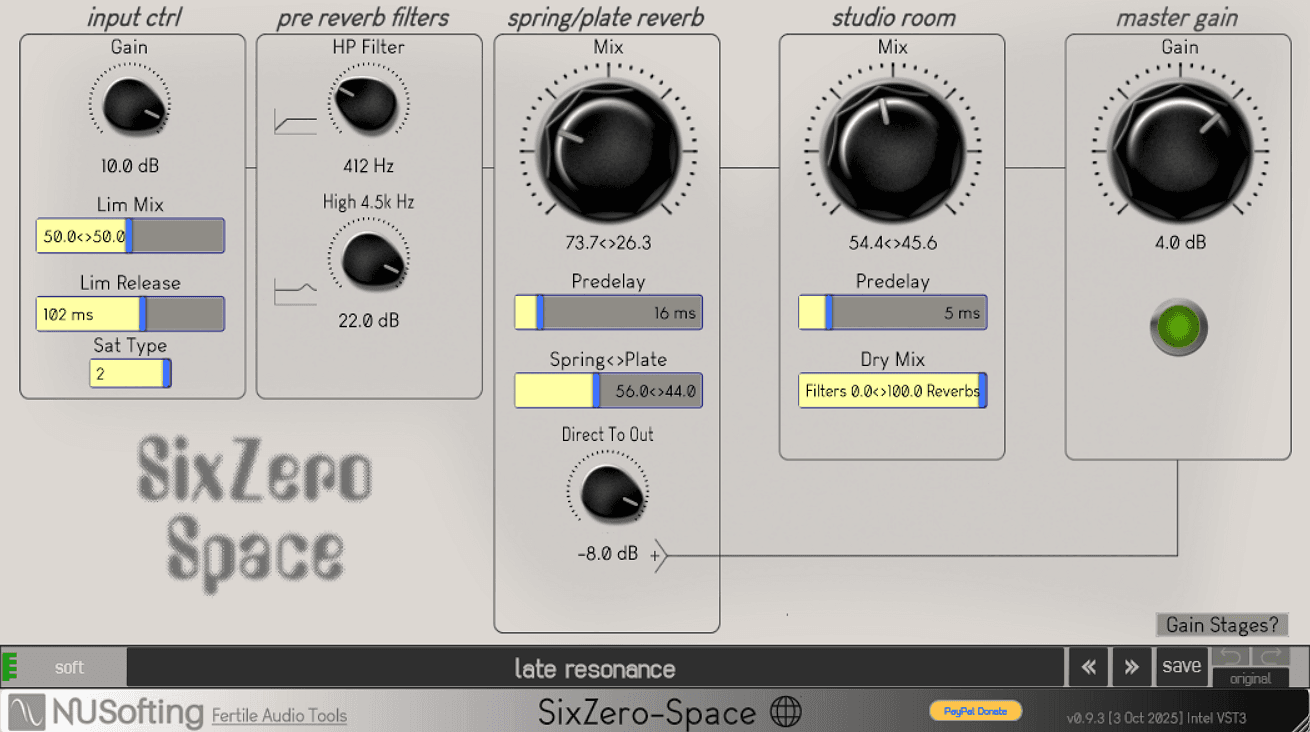
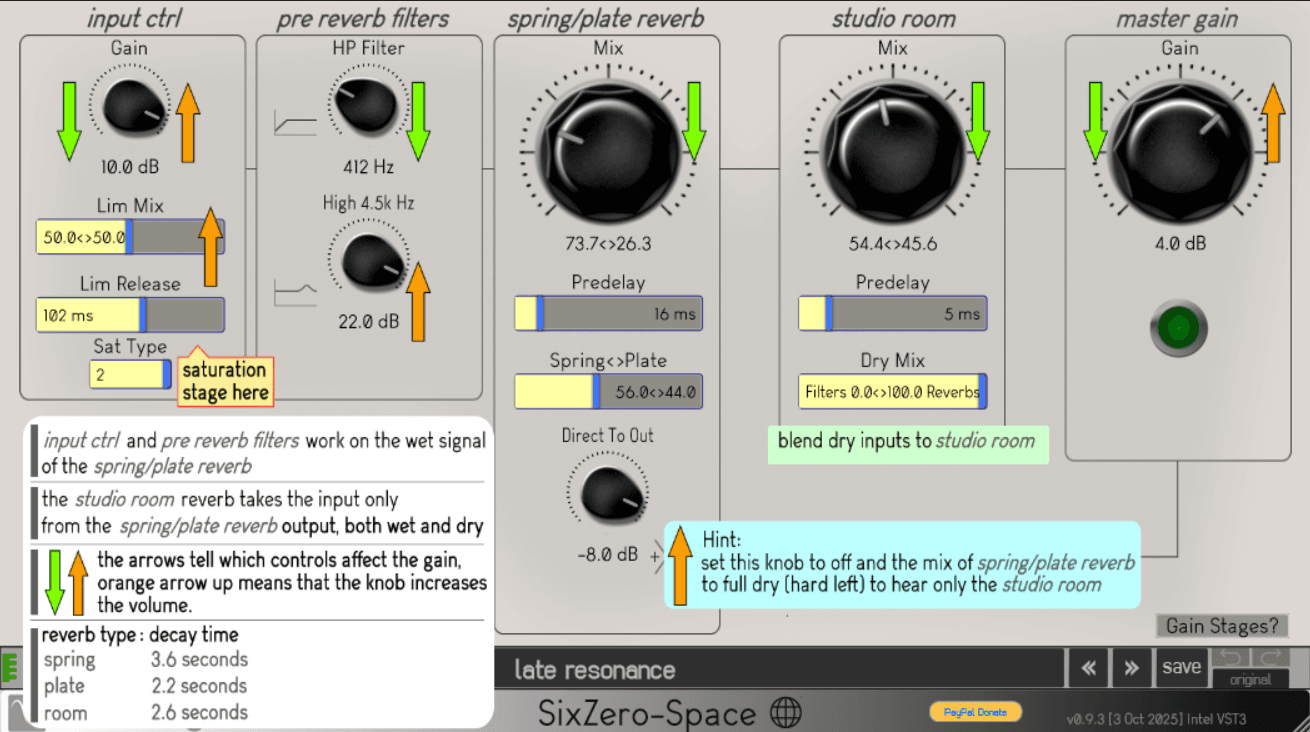
SixZero Space
€1.00
Overview
Downloads
- Price is 1 €. That's to buy the license and obtain the download link.
- Full refund guaranteed if you don't like the plug-in. No questions asked.
- Currently available as a 64-bit VST2/VST3 for Windows 10/11, [native macOS AU/VST3 will follow soon]
Use Examples
💡 Example Use Cases for SixZero Space
🎤 Vocal Track Magic
| Use Case | Settings Focus | Description |
|---|---|---|
| “Dry Studio Slap” | Pre-Delay, Spring, Saturation | Achieve that intimate, short slapback echo heard on many 60s ballads. Use a long pre-delay, a very short Spring decay, and push the Gain Stage gently for a warm, slightly squashed sound that brings the vocal forward. |
| “Motown Chamber” | Plate, HPF, Room Ambience | Recreate the dense, metallic character of famous studio chambers. Max out the Plate Reverb decay, apply the High-Pass Filter (HPF) to clean up the low-end mud, and blend in a touch of Room Ambience for body. |
🎸 Guitar & Instrument Tones
| Use Case | Settings Focus | Description |
|---|---|---|
| “Surf Rock Drip” | Spring Reverb, High-Freq Boost | Essential for that classic, over-the-top tremolo and surf sound. Use the Spring Reverb almost exclusively with a fast, bright decay. Use the High-Frequency Boost to add sparkle and the “drip” effect. |
| “Tape-Saturated Organ” | Limiter, Saturation, Room Ambience | Give a thin-sounding keyboard or organ the thick, slightly distorted texture of being recorded to tape. Bypass the reverb, use the Limiter to control dynamics, and drive the Saturation hard using the Unconventional Gain Stages. |
🥁 Drums & Percussion
| Use Case | Settings Focus | Description |
|---|---|---|
| “Lo-Fi Drum Kit Colour” | Saturation, Limiter, HPF | Apply the effect as a parallel process on the drum bus. Drive the Saturation heavily for grit and use the Limiter to glue the transients. Use the HPF to keep the kick drum punchy while adding vintage colour to the snare and cymbals. |
| “Punchy Gated Snare” | Plate, Pre-Delay, HPF | A classic 80s trick, but using a vintage plate. Use a medium-long Plate Reverb decay, a small amount of Pre-Delay, and aggressively cut the reverb tail using a subsequent gate (not part of the plug-in, but a common technique) to create a huge, punchy drum hit. |
🎚️ Master Bus Processing
| Use Case | Settings Focus | Description |
|---|---|---|
| “Full Lo-Fi Mixdown” | Unconventional Gain, Limiter, HPF | For the complete 60s vinyl feel. Apply the plug-in to the master bus. Engage the Unconventional Gain Stages gently for subtle overall harmonic distortion, use the Limiter for final compression, and set the HPF to roll off the sub-bass below (60 text{ Hz}). Bypass all reverbs for this case. |